Recent Movies
Showing posts with label Documentation. Show all posts

On Her Shoulders (2018) - Film Review

On Her Shoulders (2018)

Director
  • Alexandria Bombach
Producer
  • Hayley Pappas
  • Brock Williams
Documentary
95 minutes


Four years ago, Nadia Murad Basee Taha was a teenager living in a Yazidi farm community in the Sinjar district of Iraq when ISIL took over the town, murdered 600 people, and captured the women and girls as sex slaves. She escaped three months later and has spent most of the time since speaking out on what happened to her and her people. This month, she was awarded the Nobel Peace Prize. This award-winning documentary tells her story. 
Director Alexandria Bombach understands that there are two stories here. First there is the inspiring story of a young woman who had no ambitions of becoming a world figure but who overcame unthinkable loss and trauma by devoting herself to helping others. Then there is the story of a young woman who is forced to relive her most painful experience over and over and who is constantly bombarded by the overwhelming needs of others, from the photo-op sympathy of politicians and journalists to the heartbreak of her surviving community, most still living in refugee camps, who sob in her arms and beg her to get them some help.
Mostly, Bombach just lets the camera sit quietly as Murad goes through her exhausting schedule of meetings, media appearances, and book signings. She captures some telling images: a refugee lowering his fishing line into the ocean through a cracked panel in the fence around the camp, Murad touching a heavy chain around a locked gate, Murad’s comment on seeing a school marching band practice, “If this were in Iraq, someone would blow himself up.” She gazes into a beauty salon mirror as her hair is wrapped around a curling iron. In one of her appearances before a UN assembly, we will learn something about what her long hair means to her. 
Murad wants the world to hear her story and she is focused on a particular goal. She wants to be on the agenda of the meeting of world leaders in New York, to ask them to declare what happened to her people an official genocide and to give them justice. The process for getting the opportunity to speak to the assembly of Presidents and Prime Ministers is a daunting one. Early in the film she is preparing for what amounts to an audition. She will speak to a committee at the United Nations, and if she passes muster, she can move up to the next level. 
The time limit is strict. Her rehearsal for the initial presentation is 50 seconds over time so she has to figure out what to cut. If she takes out too much detail, the plea for help will have no weight. If she takes out the plea, she will leave without presenting a challenge to be met. When she has to shorten the speech for the final version, she eliminates the call to the world leaders to imagine what it would be like to be enslaved by ISIS because “What’s the benefit of asking them to imagine?”
The film’s most affecting moments are when Murad speaks directly to the camera. She says that the only way she can deal with what she has suffered is to devote herself to helping the other girls who suffered, too, but do not have the opportunity to bring their stories to the world. She says she feels worthless, and will always feel that way until her people get justice. 
She was content in her home in Sinjar, she tells us, doing chores, tending sheep, spending time with family, and hoping she could become a hairdresser, a place “where women and girls would see themselves as special.” She wishes that people would know her as an excellent seamstress or athlete, not as a victim of ISIS terrorism.  
It is at best bittersweet when she is named a goodwill ambassador by the UN. Her title carries as much tragedy as honor: Goodwill Ambassador for the Dignity of Survivors of Human Trafficking. As Murad makes clear in her three minutes, there is no dignity without justice. There is only one border, she tells the presidents and prime ministers, “the border of humanity.” We see this movie to learn who the young Nobel Peace Prize winner is, but in the end, it is about her challenging us to learn who we are.


#REVIEWSATURDAY - WON'T YOU BE MY NEIGHBOR (2018) - FILM REVIEW

Won't You Be My Neighbor? (2018)


“Won’t You Be My Neighbor?” presents the history of Fred McFeely Rogers, Presbyterian minister, children’s advocate and the most beloved Republican since Abe Lincoln. Like Honest Abe, Mr. Rogers was known for wearing a specific article of clothing and his ability to sweet talk a Congressman or two. From 1968 to 2001, Mr. Rogers kept millions of little ones out of their parents’ hair by offering a half hour program designed to counter the cartoon violence and frenetic pacing of practically every other kids’ show on the air. On PBS, he sang, offered advice and worked a cat puppet whose feline vocal tic drove my mother absolutely insane. 15 years after his death, the heroic endeavors of Fred Rogers are finally being celebrated on the big screen.

One of the many “stand up and cheer” moments in Morgan Neville’s enchanting documentary, at least for me, is when cellist Yo-Yo Ma describes his first meeting with the man who will forever be known as the proprietor of “Mister Rogers’ Neighborhood.” “He scared the hell out of me,” says Ma. I felt vindicated, because when I was a kid, Mr. Rogers terrified me too. He made me nervous, a condition exacerbated by my cousin telling me that he was actually a serial killer. According to her, Mr. Rogers lured people on his show and then decapitated them with the Museum-Go-Round.


Whatever Mr. Rogers was up to, watching his show made me uneasy; he was just too mild-mannered, too quiet and too calm. That felt odd, because the environment of my upbringing was anything but calm and quiet. My sister thought he was magical, though, proving that old adage about girls figuring out things long before boys do. Eventually, I came around to her way of thinking, and it only took 24 years before I realized just what it was that made Mr. Rogers so beloved and so effective.

More on that later. “Won’t You Be My Neighbor?” puts to rest many of the most common rumors about Mr. Rogers. It does so in the same blunt yet understated way that its subject dealt out information to kids. The “torso full of tattoos” rumor is addressed by showing Mr. Rogers swimming his daily mile in the local pool. To my chagrin, there’s no mention of on-set violence featuring buildings from the Land of Make Believe, but the film makes up for that by revealing the inspiration for the puppet who lived inside the Museum-Go-Round. It’s a hilarious moment that shows that respectable Mr. Rogers could also be mischievous—and petty!

Rather than rely on celebrities or viewers espousing what Mr. Rogers meant to them, “Won’t You Be My Neighbor?” makes judicious use of a few people closest to the man or his neighborhood. These include his wife, Joanne and their children plus castmembers David “Mr. McFeely” Newell, François “Officer Clemmons” Clemmons and Joe “Handyman” Negri. Negri in particular makes the neighborhood set sound like a riotous party, but everyone leans into the idea that, under Mr. Rogers' sweet exterior was a true radical. And maybe even a clairvoyant: In a clip from the Neighborhood’s first week on the air, the Land of Make Believe’s “benevolent monarch” puppet King Friday XIII issues a proclamation to build a wall to keep “undesirables” out!

“Won’t You Be My Neighbor?” makes this “he’s a radical” idea credible. After all, a troublemaking idea existed in the titular song that Mr. Rogers sang to the kiddies at the beginning of each show. Here was a White man inviting everyone to live in his ‘hood, regardless of color. “I have always wanted to have a neighbor just like you,” he sings, a sentiment that wasn’t shared by most Americans in the still-segregated era when "Mister Rogers’ Neighborhood" premiered. (Eddie Murphy’s brilliant parody, “Mister Robinson’s Neighborhood,” excerpted here in a brief clip, seizes upon this “Fear of a Black Neighbor” notion and runs with it.) But Mr. Rogers’ true genius was showing by example, and Neville highlights two memorable instances of this.

The first is Mr. Rogers’ early appearance before Congress on behalf of funding for LBJ’s newest creation, the Public Broadcasting System. Facing an adversarial Senator Pastore, who had already made up his mind to pan PBS, Mr. Rogers makes his argument by simply reciting the words to a song he had written for his show. Pastore folds immediately. “You’ve just earned your $20 million,” he says. You wouldn’t buy this in a Jimmy Stewart movie—and God help us if this had to play out in today’s Washington D.C.—yet you can find this fascinating footage on YouTube.

The second instance of Mr. Rogers leading by example occurs with the character of Officer Clemmons. As an African-American, Clemmons was at first hesitant to play a cop on the show, but he realizes the importance of kids of color seeing a friendly, familiar-looking face as law enforcement. Even more importantly, he participates in a bit where Mr. Rogers basically gives the finger to the notion of segregated swimming pools by inviting Clemmons to join him in a very small wading pool. Neville intercuts this scene from the show with footage of White lifeguards pouring bleach into a pool where Black kids were swimming.

Clemmons also figures in an incident where Mr. Rogers wasn’t so enlightened. Someone from the show discovered that the then-closeted at work Clemmons had been to a gay bar. “I had a good time!” says Clemmons, who was then told that any future bar visits would result in his termination from the show. I can only imagine which Land of Make Believe puppet got tasked with informing Clemmons that Mister Roger’s Neighborhood did not have a Castro District. (I hope it was Henrietta Pussycat saying “meow meow gay bar meow meow nuh-uh meow meow fired!”) But at least Clemmons informs us that Mr. Rogers “eventually came around” to acceptance.

“Love is at the root of everything,” Mr. Rogers tells us in an early clip, “or lack of it.” Like his fellow puppeteer and PBS colleague Jim Henson, Fred Rogers used puppets to deliver much of his message. His first puppet, Daniel Striped Tiger, serves as an animated avatar between segments because, as Mrs. Rogers points out, Daniel was an evocation of her husband’s childhood feelings of insecurity and his need to be loved. It’s hinted that Mr. Rogers was bullied as a heavyset kid—he was called “fat Freddie” and picked on, which may have led to his insistence in adulthood that a child’s feelings were as important as any adult’s. Folks are quick to point out, however, that while Daniel represents innocence, Mr. Rogers also does the voice of King Friday XIII, who clearly represents that adult need to always get one’s way.

Looking at “Mister Rogers’ Neighborhood” with adult eyes is rather fascinating. You notice that there’s a clear distinction between imagination and reality—we’re never lead to believe that the puppet segments are anything but pretend, for example. Mr. Rogers never talks down to his viewers, nor does he really sugarcoat uncomfortable things like anger or death. He’s very matter of fact, and his manner was deliberate, constant and repetitive. Which leads me to my moment of Mr. Rogers clarity.

Many years ago, I’d come home from my Wall Street job in a state of great agitation and upset. I was stressed out, worn out and miserable beyond measure. I absent-mindedly turned on the television and went into the kitchen to make dinner. For some reason, my TV was on PBS and I could hear Mr. Rogers talking from the other room. Despite paying only half an ear’s worth of attention, I suddenly realized what it was that earned the undying love of kids like my sister: Mr. Rogers made you feel like someone gave a damn about you. He said you were special. He did NOT, as the jackasses at Fox News and the Wall Street Journal claimed in hideous failure-blaming articles, promise you success or glory. He just told you that, no matter what you looked like, how able you were or how much money you had, that you had value.

I stood in my kitchen listening to this message, which I of course should have already known as an adult,  and I started to cry. I tell you this because I had the same reaction at the end of “Won’t You Be My Neighbor?” I sat in the critics’ screening room holding my notepad up to my face so that nobody would know I was sobbing. Now, if someone like me, whose childhood memories of Mr. Rogers involve rumored mass murder sprees, could have this reaction, you can only imagine what this film will do to you if you’ve always loved this man. Bring Kleenex. Lots of it.


An exploration of the life, lessons, and legacy of iconic children's television host, Fred Rogers.

Director:


Official Sites:

Official site

Country:

Language:

Release Date:

8 June 2018 (USA)  »

Company Credits

Production Co:

MIDNIGHT HORROR - DEMON HOUSE (2018) - FILM REVIEW

Demon House (2018)


Paranormal investigator Zak Bagans documents the most authenticated case of possession in American history.

Director:

Writer:

Stars:


Zak Bagans, host of the Travel Channel series “Ghost Adventures,” is in the ghost-believing business—his livelihood depends on viewers thinking that the supernatural exists, somehow. He takes that passion to the film world with the documentary “Demon House,” in which he thinks he has the Big Kahuna of ghost story opportunities: a crumbling house in Gary, Indiana that has been written about in various outlets for its demonic activity, and might even have a portal to hell in the basement. Purchasing the house right before he brings a crew to Indiana, Bagans essentially hopes the estate will help prove that ghosts are real, a goal that “Demon House” assuredly falls short of, and then some. 


So that you don’t have the same nagging curiosity that I did while first watching it, I can verify that this is a documentary by form and not just a post-“The Blair Witch Project” found footage con. The truth to the supernatural events in Gary is still nonetheless difficult to pin down, however much sensationalized journalism they inspired, but Bagans knows who he can use to corroborate his adventure: a woman like Latoya Ammons, whose children expressed different episodes of being possessed, a superstitious police officer, a priest who does exorcisms, etc. Experts are not consulted, nor are any party-pooping skeptics invited. It's telling that "Demon House" features a real-life exorcism, but it feels more superficial than supernatural. 
“Demon House” in part has Bagans collecting previous accounts about the house's goings-on, complementing them with goofy reenactments that provide anti-tension, especially when it comes to scenes of the Ammons kids freaking out with their eyes rolling to the back of their heads, or screaming in a strange voice. But the bad spirits, or so Bagans and company would like you to think, are ever present, and “Demon House” offers first-hand accounts of him and his crew capturing strange sounds, filming a shadow in a doorframe, or seeing rising levels of magnetism in the basement, etc. Sometimes there's even surveillance footage of himself or others seemingly briefly possessed. With little filmmaking tact other than trying to prove he’s right, it amounts to a hammy enterprise, like his numerous unfortunate freeze frames that create accidental punchlines whenever someone says something ominous. 
Happenings do get stranger as Bagans’ investigation continues, offering a fleeting hope that this could be the rare horror documentary that’s actually scary. Bagans’ cameraman Adam is later affected by being in the house, and a parapsychologist named Barry Taff (author of Aliens Above, Ghosts Below) experiences physical repercussions, or so we're told. (The kookiness of “Demon House” might have fared better if it were more a sociological look at people who believe this stuff, looking at it not from Bagans' perspective, but I digress.) As “Demon House” yearns to have its own real-life moments from something like a “Paranormal Activity” movie, Bagans’ film still offers plenty of skepticism, especially whenever it seems possible that it's only the bad acting from the child reenactments that's possessing Adam or Barry's dramatic turns. It proves to be incredibly tedious when you can’t trust your documentarian or even the possible true suffering of his friends, as they collectively inspire more of a “who cares?” than “who knows?” reaction about the existence of demons and whatnot. 
But it proves to be shocking most of all watching the doc that Bagans has at least 100 episodes of “Ghost Adventures” behind him. Aside from the authority he claims on-camera when playing ghost host, he’s a notably dull surrogate into these possibly supernatural events. His voiceover sounds tired, and his words lack even more spirit: “This is the case that really f**ked me up.” Followed up later by, “This was some serious sh*t that meant something.” And then his glorious send-off: “Like I said at the beginning, this story is cursed.” Maybe that shrugging nature is fair game in between commercial breaks, but within a feature-length documentary it makes him all the more a storyteller you can't believe, or trust. 


Country:

Language:

Release Date:

16 March 2018 (USA)  »

Also Known As:

Демонический дом  »

Filming Locations:


MY PERSONAL BELIEVES OF MUSIC ALL PUT IN A DOCUMENTARY - WHAT WE STARTED (2018) - FILM REVIEW + PERSONAL NOTES

A couple of days ago some people were asking me why I love to mix. When I listed to the music I am doing, when I am listening to techno and deep tech I feel freedom, I feel love, and I feel passion. I can be byself and just be with the music. Electronic music makes me happy, it makes me reveal stress and bad feelings. I feel so deep in love and life, I forget about my bad past and I am able to experience the best thing in the world, that I can fly. So I created this review and post to make you understand what is the story behind Electronic music, what it does to people and where it came from and where it leade and brings us.

What We Started (2017)


Stars:


Credited cast:
Steve Angello ...
Himself
Carl Cox ...
Chip Eberhart ...
Himself - Chip E.
Martin Garrix ...
David Guetta ...
Himself
Erick Morillo ...
Himself
Paul Oakenfold ...
Himself
Usher Raymond ...
Himself
Ed Sheeran ...
Himself
Tiësto ...
Himself
Pete Tong ...
Louis Vega ...
Himself


Who is the "we" in Bert Marcus and Cyrus Saidi's What We Started? This look at electronic dance music speaks of the genre's origins — in Manhattan disco, Detroit techno, etc. — in the third person, and incompletely; the interviewees we do hear from are mostly those who rode predecessors' coattails to fame and fortune. Nevertheless, the throbbing documentary tells enough of the story to show today's legion of David Guetta fans where he and his peers came from. Viewers who suspect this scene's superstars will be in 20 (or 10) years will likely remain unconvinced when the credits roll.

Opening scenes suggest the worrisome prospect that Started will focus exclusively (or mostly) on two dissimilar DJs: Carl Cox, the British house DJ who enjoyed a 15-year residency at Space Ibiza; and Martin Garrix, the Dutch wunderkind who headlined the main stage at Miami's Ultra Music Fest when he was still a teenager. Both prove to be fine company, but neither seems doc-worthy. Fortunately, they're not the only beat-droppers we'll meet here.


As the film approaches the 10-minute mark, it takes a break for a short look back at the roots of DJ-centric dance events. John Lyons (identified only as a "nightclub pioneer") recalls a time when bars thought they needed live music to attract dancing patrons. Who would pay to spend time in a club with just a guy spinning records? ("But what if the guy stuck his hands in the air a lot while he was playing?!," one imagines Skrillex suggesting.)
Obviously, people came out. We've barely heard the name Larry Levan, though, before the film has moved on from disco, name-checking Chicago's house music and Detroit's techno. You'll be forgiven if you get through these quick scenes and still have no idea what the difference was between these two spinoff genres; the film is mainly interested in following their influence to England and Ibiza.
Bizarrely, it basically ignores hip-hop's contribution to the art of the DJ — an art that would likely still be in the stick-figure phase without rap culture's influence. And it is not interested in the 1980s synthpop that had a similarly profound effect on the dance-remix auteurs soon to become stars. Instead of musicology, Marcus and Saidi focus their attention on the social environments in which DJs came to be the focus of attention: They spend lots of time with the men who found ways to turn the English rave culture of the late '80s into a very lucrative nightclub community.
Somewhere in here, what had been a subculture became the stuff of Spring Break and outdoor music festivals. Perhaps because it wants to play to both sides, the film's viewpoint is awfully muddied when it addresses conflict between traditional DJs — who know how to handle turntables, read a crowd's mood and do their thing for many hours at a time — and those who premix a whole set to a USB stick, hit play and just bounce up and down onstage. Does the latter group (which represents the genre's most successful entertainers) deserve our disdain, or have they developed some new art the old-timers just don't get? The doc's verdict seems to be that whatever draws the biggest crowd wins.

Aims to establish itself as the defining film of the electronic music genre. Through an artfully crafted narrative and stunning visual techniques, the film delves into the highly popular world of electronic dance music, providing backdoor access to a widely misunderstood, self-driven and well-insulated industry on its way to global domination. The narrative leads with the legacy of Carl Cox and following with newcomer, Martin Garrix, as the film explores the parallels between Cox's undeniable influence and hand in the evolution of dance music and Garrix's formation of mainstream genres and global fame.  

Pete Tong: WHAT WE STARTED will instantly capture an audience's attention. This is a film that gives an authentic voice to different generations of this movement in an unprecedented way and leads you on a globe-trotting journey that explores a dynamic and multi-layered industry. As someone who spent my whole career in electronic dance music, I'm very excited to be involved in this ambitious film that goes a long way to set the record straight on how we got here!


Official Sites:

Country:

Language:

Release Date:

March 2018 (USA)  »

Company Credits

Production Co:

DID YOU WONDER WHO FIRED THE GUN? (2018) - FILM REVIEW

Did You Wonder Who Fired the Gun? (2017)


A documentary murder mystery about the filmmaker's family, set in lower Alabama.

Director:

A documentary murder mystery about the filmmaker's family, set in lower Alabama, 18 miles north of the Florida state line. On an October night in 1946, S.E. Branch twice shot a man named Bill Spann in the small neighborhood market that Branch owned. Two days later, Spann died in a segregated black hospital. Branch was white-a Klansman-and Spann was black. Branch claimed self-defense, but despite that claim and the political climate in Dothan, Alabama in 1946, Branch was charged with first-degree murder. S.E. Branch was the artist's great granddaddy, on his mother's side. Everyone says they looked alike. That this story echoes across decades and generations says much about the distance travelled by U.S. society since 1946.  

Country:

Language:

Release Date:

28 February 2018 (USA)
Travis Wilkerson’s “Did You Wonder Who Fired the Gun?” is more of a personal exorcism than a traditional documentary. In fact, it premiered as an even less-traditional film experience, playing at Sundance and other festivals as a live event, during which the filmmaker/narrator spoke in person and exalted the audience to even participate in the unearthing of racial demons. Now condensed into a cinematic experience and getting a limited release, it’s hard to shake the idea that the “live documentary” approach isn’t a little more satisfying for this material, but it’s impossible to deny the power of much of what’s on display here. Wilkerson looks at the racial discord and violence in the world around him and has the courage to examine his own legacy instead of just casting off the concept as something that happens to or is perpetrated by others. It’s worth considering how much better off we’d all be if we did the same.

Wilkerson opens by comparing his story to that of one of the most legendary literary characters of all time, Atticus Finch in “To Kill a Mockingbird.” Like Finch’s saga, this one will have a crime and a court case, but Wilkerson is quick to point out the comfort of fiction doesn’t often happen in the real world. Wilkerson’s relatives are not Atticus Finch—in fact, no one really is—and one of them was more likely to be a member of the lynch mob than the upstanding citizen who stopped them. After the George Zimmerman verdict, Wilkerson decides its time to open the closet full of skeletons in his family home and examine his own racist lineage. 

In 1946, S.E. Branch shot Bill Spann. That is historical record. Branch, Wilkerson’s great-grandfather, owned a small store in Dothan, Alabama, and Spann was in the store. What exactly Spann was doing became an object of controversy, but the important thing to know is that Spann spent almost no time in jail. 70 years ago—not that long if you think about it—a white store owner shot a black man in cold blood and didn’t do any time. How did that happen? Wilkerson starts with this very simple question, and, very refreshingly, allows the answers to guide his filmmaking. This is no simple “murder mystery documentary.” At its best, it has a very organic flow, allowing us to follow the threads of personal and national history with its creator. For example, he runs into a neighbor next to the building that used to be his great-grandfather’s store and so he interviews her. He regularly shows us looping footage of Southern roads. We are on this journey with him. 

Perhaps the most interesting aspect of “Did You Wonder Who Fired the Gun?” is also one that I wish Wilkerson explored a bit more in-depth, and that’s the idea of the wounds left on parts of this country by racial violence, and how there is a ripple effect, both negative and positive, to all of this. He presents shots of places in Dothan that simply look like they have history embedded in them and speaks of not being able to walk in the former store without feeling the ghosts under his feet. There are thousands of places like this in the country, places forever redefined by violence. 

And then he takes this history of violence a step further, visiting nearby Abbeville, where the rape of Recy Taylor took place, and noting how that incident inspired Rosa Parks to take the action she did so many years later. What will the events of today inspire us to do tomorrow? Wilkerson breaks his film regularly to present the names of murdered men and women, asking viewers to say their names, including Sandra Bland, Trayvon Martin, Eric Garner, and more. His film isn’t as much of a call to action as a call for reflection. Yes, we can march and protest, but we will get nowhere until we look into our own histories and say the names of the people we find there. 

There are times when I longed for the visceral, immediate aspect of seeing “Did You Wonder Who Fired the Gun?” in person and it’s often difficult to translate these experiences that approach performance art as much as film into something that can play in theaters. In this case, Wilkerson got most of the way there, even if a few of his bits of heated narration probably play better live. Most of all, he’s made a film that’s hard to shake. There are hundreds of movies about the racial issues that continue to divide this country, but few that feel this personal or this pleading. 
 Thanks for reading and have fun watching movies.

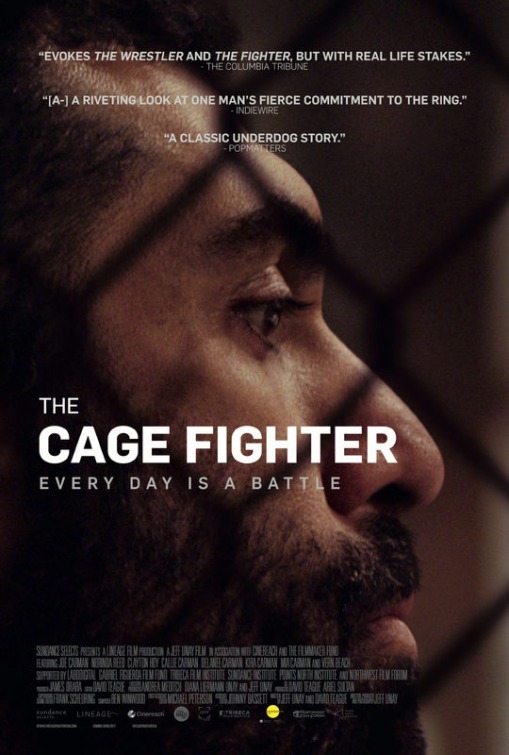
THE CAGE FIGHTER (2018) - FILM REVIEW

The Cage Fighter (2017)


A blue-collar family man breaks the promise he'd made to never fight again. Now forty years old, with a wife and four children who need him, Joe Carman risks everything to go back into the fighting cage and come to terms with his past.

Director:

Stars:


Official Sites:

Country:

Language:

Release Date:

2 March 2017 (USA)  »

Also Known As:

Greywater  »

Filming Locations:


Box Office

Opening Weekend USA:

$1,204, 4 February 2018, Limited Release

Gross USA:

$1,204, 4 February 2018

Company Credits

Production Co:


In the parking lot of a gym where he sometimes works as an instructor, Joe Carman is turning a huge tractor tire over, and over, and over. There’s a guy who’s spotting him—inasmuch as you can spot someone who’s manhandling a gargantuan slab of rubber—and Joe asks the fellow, “How old are you?” “24” is the reply, and Joe responds, gruffly but wistfully, “Oh, I wish I was 24 again.”
Joe wishes a lot of things. Mainly, he wishes to continue a sideline career in cage fighting, the semi-pro subset of mixed martial arts. Now 40, on his second marriage, a doting father to four daughters, Joe makes his living in a boiler room working for the Seattle Ferry service, doing maintenance. But he lives to fight. Being 40 isn’t the only problem with this determination. The fact that he’s promised his family that he won’t is another. 

“The Cage Fighter” is a documentary directed by Jeff Unay, who has a background doing post-production effects work for movies such as Peter Jackson’s “King Kong” and James Cameron’s “Avatar.” This is not the movie you’d necessarily expect from him, but his background definitely influenced his storytelling style. This brisk, concise movie (it’s only 80 minutes long) combines a you-are-there feel with an innate sense of storytelling structure. Even an ordinary event like Joe making pancakes for his kids is shot and edited with an economy and sense of purpose related to dramatic narrative. This, combined with the fact that Joe is likable, and his daughters at least are appealing foils, makes “The Cage Fighter” a movie that’s a pleasure to watch. 

Your mileage may vary depending on how tightly you latch on to the story. Although it’s a documentary, “The Cage Fighter” teems with characters that are familiar from fictional tales. Goodness knows that the almost-washed-up-boxer is a stock character nearly as old as cinema itself. “The Cage Fighter” gets some extra juice from the fact that Joe’s compulsion to continue fighting is in some sense a mystery even to himself. When he’s in the ring, he says to his furious wife, “I’m proud of myself … I like me.” But in a sense you can see he knows he’s making excuses. His oldest daughter, not without affection, calls him out pretty sharply: “One more fight, I have to redeem myself … one more fight, I need closure,” she says in an unsparing impersonation of her dad. 

Some clues as to what drives Joe come out when the fighter visits his own dad, a lout of near-staggering proportions who serves as a negative role model. And the mystery of what drives a man to seek glory in cage fights is underscored in two scenes. In one, a colleague observes “Cage fighters are like strippers …we’re cool to hang out with, but not much else … something has to be wrong with us.” And late in the film, Joe sits down with Clayton Hoy, a much younger MMA star whom Joe hopes to at least face off against some time. Over beers, Hoy reveals to Joe just how much of a mess his own life has become. Getting beat up for little money and a very particular amount of attention—what’s the deal with that? Thinking that despite all the good things you’ve got in life, there has to be something more isn’t just a crisis in masculinity, as this movie unavoidably frames it; it’s possibly part of the human condition. “Discipline is an act of freedom” is an adage painted on the wall of Joe’s gym. You could substitute “acceptance” for “discipline” and still be correct. Is Joe’s lack of acceptance a mental block that will eventually deprive him of everything he’s got, or is it a motivating force that will push him to greater heights? The movie ends with the question unanswered … but the odds don’t seem to be in Joe’s favor.


Thanks for reading and have fun watching movies.

AROUND THE WORLD - THE ROAD MOVIE (2016) - FILM REVIEW

The Road Movie (2016)


Country:

Language:

Release Date:

19 January 2018 (USA)  »

Also Known As:

Дорога  »

Filming Locations:


Box Office

Gross USA:

$24,681, 25 January 2018

Company Credits

Production Co:


Russian dashcam videos—the ones that show dashboard footage of ridiculous car crashes and random madness on the roads of the Motherland—became popular on the Internet presumably because people enjoy watching chaos from a distance. Mayhem, especially found mayhem, can be genuinely entertaining, and many of these videos honestly live up to their ludicrous, brutal reputation. Of course, there are social and political reasons for the prevalence of dashcams in Russia (a check against widespread insurance fraud and police corruption), as well as for the country’s high rate of car accidents (crumbling infrastructure coupled with nasty winters tend to create poor road conditions), but these videos flatten out all those tangible complications. Queasy implications of layered voyeurism notwithstanding (after all, you are watching a stranger watch real destruction), Russian dashcam videos simply satisfy a broad “football in the groin” desire that many folks, including myself, hold dear.

That might be a protracted justification for entertainment that’s in the same ballpark as, say, Roadrunner cartoons, but it goes a long way of explaining the base appeal of “The Road Movie.” Dmitrii Kalashnikov’s debut feature is a 70-minute compilation of these dashcam videos uploaded to the Internet by Russian citizens. These videos run the gamut from manic car accidents to utterly surreal encounters. Kalashnikov, who serves as the film’s editor, selects videos that have their own internal rhythm, yet they all follow a familiar structure: a calm, then a storm, and then the aftermath. “The Road Movie” operates on a unique tonal wavelength, one that’s both manic and oddly comforting. It may be an anthology of bedlam, but it eventually settles into a calming mode that derives from a director providing his audience exactly what they signed up to watch.

Describing any of the clips in “The Road Movie” at length will inevitably do a great disservice to the experience of actually watching them, especially since they’re predicated upon shock and awe. However, some of the highlights from the film include a drunken joy ride that lands a car in a river (“We are sailing,” one passenger calmly states as the vehicle floats downstream), a humorous yet mundane conversation between a taxi driver and prostitute about fee structure, and a car chase in which the police are downright incapable of quartering their suspect. Each “scene” has its own identity, but when juxtaposed against similar events, they become a tapestry of the absurd.

Maybe it goes without saying, but “The Road Movie” is very funny, albeit in the pitch-black sense. Much of the humor comes from the passengers’ po-faced narration to disorder just outside their window, or casual asides right before an accident, such as when a driver remarks, “Man, it’s not even stylish … to wear a sombrero in the car” just before another car crashes inches away from them. It’s not quite accurate to say that “The Road Movie” demands that you laugh at people’s pain, but it does ask the audience to treat the bizarre with a certain amount of levity, even if the surrounding reality is fairly disturbing.

Kalashnikov opens up a few interpretive pathways with “The Road Movie.” Someone could make the case that the film wryly captures something specific to the Russian character, though I’m struggling to suss what that would be, considering that “road rage,” “recklessness,” and “bystander apathy” are common to Americans as well. Kalashnikov mildly interrogates the nature of unconscious performance in moments of extreme terror. How much are the passengers “acting” for the camera during these scenes? If the camera isn’t pointed at them, does its presence still amplify their behavior? Admittedly, he doesn’t answer these questions, but he foregrounds them to an extent, particularly in scenes that linger on the aftermath of an accident. There are also a couple severe breaks from Kalashnikov’s voyeuristic approach that suggests an attempt to push the viewer from observer to active participant.

Yet, I’d be remiss if I didn’t say that “The Road Movie” works best as spectacle. Kalashnikov’s editing schema, with its thematic rhyming and seamless transitions, elevates “The Road Movie” above supercut status, but it still plays like a greatest hits tape. Frankly, there’s nothing wrong with that. It might be slight, but “The Road Movie” never overstays its welcome and rarely becomes monotonous, which is remarkable given the nature of the beast. It’s designed to provoke laughter and raised eyebrows, and it does exactly that with minimum fuss. Sometimes you want heart, and other times you just want a football in the groin.
 

*** 

 Thanks for reading and have fun watching movies.

[FROM INDIA IN CINEMAS NOVEMBER 30] BRIMSTONE & GLORY (2017) - REVIEW

Brimstone & Glory (2017)


Ecstatic ritual, danger and the absolute beauty of fireworks. 
 

Official Sites:

Country:

|

Language:

Release Date:

2 March 2017 (USA)  »

Box Office

Opening Weekend:

$2,125 (North America) (29 October 2017)
 »

Company Credits


Technical Specs

Runtime:

Color:

Aspect Ratio:

1.85 : 1 
 
 
Small towns live and die according to what seem like whims of fate. But just as every great fortune has its origin in a great crime, every small town that survives has a particular economic motor. Some are more interesting than others. The Mexican town of Tulpatec survives through pyrotechnics.

“Brimstone and Glory,” directed by Viktor Jakovleski and backed by some of the talents behind “Beasts of the Southern Wild,” is a documentary about that town’s annual Pyrotechnics Festival, an event that, it seems, is prepared for year-round by its residents. The fireworks engineered in this place, north of Mexico City, aren’t Macy’s Fourth of July high-tech displays, precision engineered and digitally controlled. But they’re not crude either. One hallmark of the festival is the evening devoted to large sculptures of bulls, each one packed with explosives. The point of this display is to have the bull as a launching site for various light-and-sound spectacles while never burning or in any other way damaging the sculpture itself. It’s like creating a candy-dispensing piñata that remains whole. There’s a lot of ingenuity required.

And there’s a lot of danger involved. Injuries during these festivals are common. Town elders tend to be cheerful fellows who are missing an eye or a limp or several fingers. Young kids working on fireworks projects are praised for having “gunpowder in the blood.” The film doesn’t have to push hard on a thesis about how economy determines culture. The town is an organic demonstration of it.

There are religious roots to the festival. It’s dedicated to a Portuguese saint who, according to legend, rescued the patients of a burning hospital without suffering a single burn. The day-to-day life of the town is lived in constant proximity to deadly materials—large signs reading “Peligro” are everywhere. The scenes of the preparations of the explosives are fascinating, particularly because everything is so analog. Mortar and pestle are primary tools in mixing powders and dyes.
And once the big day arrives, the nimble cameras operated by Jakovleski and his team get some awesome visuals. This is a movie that repays being seen on a big reflective screen, one on which the image is projected rather than one from which the image emanates. Because the light that comes off of the screen is strong and fierce. It’s exhilarating and scary at the same time.

The mode of this short movie is naturalistic. There are interviews of people in voiceover, but not a lot of talking-head footage. The perspective is of an observer sauntering through the town and then thrust into the middle of a fearsome but exhilarating spectacle. “Brimstone and Glory” took three years to make. I think the filmmakers needed that time to come up with a result that seems so simple and straightforward, yet has such deep resonance. 

FINAL RATING: 7/10 FOR THE GENRE AND 6/10 OVERALL. Nice fireworks collection, but I am not sure if that is worth to watch it in cinemas. Better do that at home.


Thanks for reading and have fun watching movies.

ONE OF US (2017) [DOCUMENTARY] - REVIEW

One of Us (2017)


 Penetrating the insular world of New York's Hasidic community, focusing on three individuals driven to break away despite threats of retaliation.

Stars:


Country:

Language:

|

Release Date:

20 October 2017 (USA)  »

Company Credits

Production Co:


Technical Specs

Runtime:

Color:


The title "One of Us" cuts deeply, in two directions. This documentary by Heidi Ewing and Rachel Grady zeroes in on three individuals who were once part of a tightly knit community of Hasidic Jews in Brooklyn, New York. All three eventually left the tribe, as it were, because they found its conditions for membership suffocating, even abusive. 

All three are caught by the filmmakers in the process of transforming themselves into secular Americans living life in the mainstream, enjoying the freedom that comes from being about to make bold personal choices, but also feeling abandoned and hated by the family and friends who remained on the other side. They're becoming part of a larger world now—one of "them" as opposed to one of "us," or maybe the other way around. 


Teenaged Ari endured a horrendous crime as a child that was covered up by his community; it eventually contributed to his cocaine addiction (he's survived two overdoses). Luzer is a twenty something man who realized one day that he couldn't stand to live under the constraints of the community, got a divorce, left his family New York and moved to Los Angeles to pursue his dream of becoming an actor. Etty, now 32, has the most disturbing story. She was pushed into marriage with an abusive man at 19 and has had seven children. The entire extended family plus a wider circle of friends have joined forces to stop her from divorcing her husband and starting over. 

This is complex and often explosive subject matter, and in examining it, the excellent team of Ewing and Grady (“The Boys of Baraka,” “Jesus Camp” and “Detropia") tread as carefully as they can, given the constraints they're under. Specifically, they can only tell one side of this story: the Hasidim, who rail against the secular world and are suspicious of cell phones and the Internet, aren't about to sit for interviews with these filmmakers. That means that we're never going to hear their side of things. 
This is not to say that whatever we might might have heard would have created an "one the one hand, on the other hand" dynamic—clearly, all three of the filmmakers' subjects had excellent reasons for leaving the community, and even if their reasons had been flighty or specious, they should still have had the right to determine their own destiny without fear of being ostracized or punished. That said, the most fascinating, albeit quite brief, portion of the movie comes in the form of a history lesson: we find out that the Hasidic Jewish community sprung up as a response to the Holocaust—that they see themselves as holy replacements for the millions who were slaughtered in the 1930s and '40s. Everyone, including abusers, have reasons for doing what they do; a bit more on this subject might've made an already wrenching documentary even more powerful. 

Then again, "One of Us" is so strong as-is that its more harrowing sections—particularly Ari's account of his childhood suffering and the details of Etty's fight for freedom—are so already hard to watch that you might want to turn away. There's nothing more exhilarating or more terrifying than taking control of one's own life.
 
Copyright © 2017. MOVIETOWN
Blogger Templates